

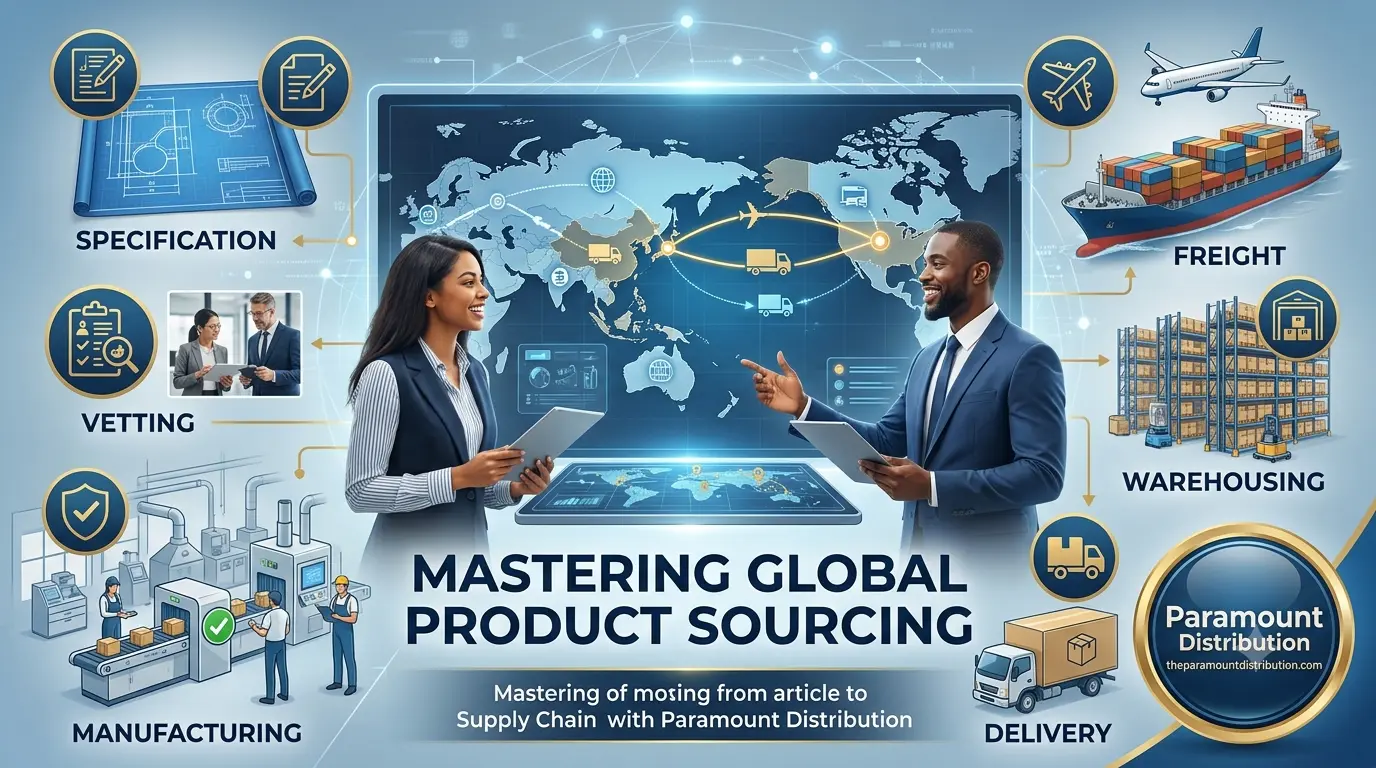
Building a sustainable, high-margin brand requires much more than a polished online store and digital marketing campaigns. At the core of every thriving e-commerce enterprise, retail enterprise, or wholesale business lies a robust operational backbone. Mastering Product Sourcing is the definitive growth driver that separates high-performing brands from businesses struggling with low profit margins, inconsistent inventory, and unreliable delivery schedules.
Modern procurement is no longer just about buying stock at low rates—it encompasses full supply chain visibility, international trade compliance, manufacturer vetting, and logistics optimization. Without a disciplined procurement strategy, businesses quickly run into inventory bottlenecks, poor quality control, and shipping delays.
At Paramount Distribution, we streamline complex global procurement operations for growing businesses. Whether launching private-label lines, expanding wholesale operations, or sourcing hard-to-find components, executing a strategic procurement strategy helps maintain inventory continuity, protect brand reputation, and scale profit margins.
What is Product Sourcing and Why is It Critical?
At its core, Product Sourcing is the strategic end-to-end process of identifying, evaluating, negotiating with, and procuring physical goods from manufacturers, suppliers, or distributors for commercial resale. It spans every stage between initial product design concepts and the final delivery of commercial inventory to fulfillment warehouses
The Strategic Value of Efficient Procurement
- Expanding Gross Margins: Directly reducing your cost of goods sold (COGS) through direct factory negotiations immediately boosts gross profit margins.
- Protecting Brand Reputation: Partnering with audited manufacturers ensures strict quality control, reducing product return rates and safeguarding customer reviews.
- Building Supply Chain Resilience: Multi-sourcing strategies and reliable distributor networks prevent out-of-stock events during seasonal demand spikes or trade disruptions.
- Accelerating Time-to-Market: Working with experienced supply chain managers streamlines sampling, product development, and freight routing so you can launch products ahead of competitors.
Core Product Sourcing Models Explained
Choosing the right inventory procurement model depends on your business capital, product complexity, order volume, and risk tolerance.
Direct-from-Manufacturer (OEM/ODM)
Working directly with Original Equipment Manufacturers (OEM) or Original Design Manufacturers (ODM) provides the lowest possible unit prices and complete control over product customizations, packaging, and intellectual property. However, this approach requires significant upfront capital, higher Minimum Order Quantities (MOQs), and dedicated quality management.
Wholesale Distributors & Jobbers
Purchasing existing finished products in bulk from regional wholesalers reduces product development time and shipping complications. While unit costs are higher than buying factory-direct, minimum order quantities are significantly lower, lead times are shorter, and inventory carries lower risk.
Turnkey Procurement & Strategic Sourcing Partners
Engaging an end-to-end supply chain manager like Paramount Distribution gives you direct access to established global factory networks, native negotiation support, local quality inspections, and streamlined freight forwarding without having to manage international trade paperwork yourself.
Dropshipping & On-Demand Fulfillment
With dropshipping, products are purchased individually from third-party suppliers who fulfill orders directly to customers. This eliminates upfront inventory costs and warehouse overhead, but results in lower profit margins, long shipping times, and minimal control over product quality.

7 Proven Steps for Successful Product Sourcing
Following a structured sourcing framework protects your working capital, ensures consistent manufacturing standards, and builds operational resilience.
Step 1: Product Specifications & Tech Packs
Detailed documentation prevents production mistakes. Draft comprehensive Tech Packs that specify:
- Exact product dimensions, tolerances, and weight limits
- Specific raw materials, finishes, and color codes (Pantone matching)
- Eco-labeling requirements, safety standards, and retail packaging guidelines
Step 2: Supplier Identification & Background Audits
Screen manufacturers across verifiable operational metrics:
- Business registration, export licensing, and factory ownership models
- ISO certifications (e.g., ISO 9001 for quality management systems)
- Production capacity, facility sizes, and current client portfolios
Step 3: Requests for Quotation (RFQs) & Unit Cost Analysis
Send standardized RFQ packages to shortlisted suppliers. Request itemized breakdowns covering tool manufacturing costs, per-unit assembly costs, export packaging fees, and sample lead times to accurately evaluate vendor options.
Step 4: Sample Prototyping & Stress Testing
Never commit to bulk manufacturing contracts without thorough sample evaluation. Conduct real-world stress tests, lab verifications, and packaging drop-tests to identify design flaws early.
Step 5: Contract Negotiation, MOQs & Payment Terms
Negotiate clear commercial terms before initiating production runs. Standard agreements should cover:
- Tiered pricing structures for scaling order volumes
- Clear payment terms (e.g., 30% deposit upon order confirmation, 70% balance upon final inspection approval)
- Penalty clauses for unexcused delivery delays or defect rates exceeding agreed thresholds
Step 6: Quality Assurance & Pre-Shipment Inspections
Set up a multi-stage quality management framework:
- In-Line Inspections (DUPRO): Check raw materials and early assembly runs when 20% to 30% of the production is complete.
- Final Random Inspections (FRI): Conduct detailed inspections using Acceptable Quality Limit (AQL) standards after 80% or more of the batch is boxed and ready for shipment.
Step 7: Freight Forwarding & Customs Clearance
Coordinate air, ocean, or overland transport with experienced logistics managers. Ensure all commercial invoices, packing lists, certificate of origin forms, and HS codes are properly prepared to avoid port demurrage fees and import holds.
5. Overcoming Common Global Sourcing Pitfalls
International procurement can introduce operational roadblocks if managed without local market knowledge and dedicated oversight.
- Communication Barriers: Technical details often get lost in translation. Clear engineering schematics, video documentation, and local procurement agents help ensure requirements are met.
- Unexpected Cost Creep: Unplanned customs duties, port handling fees, currency fluctuations, and freight surcharges can eliminate projected profit margins. Always calculate landed costs before finalizing orders.
- Intellectual Property Theft: Protect unique designs by registering local patents and securing enforceable Non-Disclosure Agreements (NDAs) tailored to overseas manufacturing regions.
- Quality Fade: Factories sometimes substitute cheaper materials after initial sample approvals to cut costs. Enforce regular pre-shipment inspections to maintain consistent quality across all orders.
Calculating True Landed Cost for Maximum Profitability

Evaluating supplier quotes based purely on unit pricing can be misleading. To protect profit margins, businesses must calculate the Total Landed Cost—the total cost of getting a product from the factory floor to your fulfillment center.
By factoring in every component of your supply chain, you can set realistic retail prices, plan profit margins accurately, and identify cost-saving opportunities across your vendor network.
Comprehensive Procurement Method Comparison
| Procurement Model | Production Lead Time | Upfront Capital Required | Gross Profit Potential | Quality Control Oversight | Best Suited For |
| Direct Factory (OEM/ODM) | 60 – 120 Days | High (Strict MOQs) | High | Requires Third-Party Audits | Established Brands & Custom Products |
| Wholesale & Distributors | 7 – 14 Days | Moderate | Moderate | Pre-Inspected by Wholesalers | Rapid Market Expansion & Standard Stock |
| Dropshipping Networks | 3 – 10 Days | Minimal / Zero | Low | Uncontrolled / Variable | Market Testing & Low-Capital Launches |
| Paramount Distribution Solutions | Fast-Tracked | Scalable & Flexible | Maximized via Managed Logistics | Fully Managed On-Site Inspections | Growing Brands & High-Volume Supply Chains |
Why Partner with Paramount Distribution for Your Supply Chain?
Navigating foreign suppliers, complex international trade laws, and quality management requires significant operational focus. Paramount Distribution serves as your end-to-end procurement partner, offering customized supply chain management that aligns with your growth goals.
The Paramount Distribution Advantage
- Vetted Manufacturing Network: Access certified, audited, and reliable production facilities across global markets.
- Transparent Cost Models: Work with clear landed-cost pricing that eliminates surprise fees and customs delays.
- On-Site Quality Inspections: Dedicated local personnel conduct factory audits and pre-shipment checks to ensure your standards are met every time.
- End-to-End Freight Management: Benefit from consolidated air, sea, and land logistics that optimize transit times while keeping shipping costs low.
Conclusion
Mastering Product Sourcing is not a one-time operational checkmark—it is an ongoing, strategic discipline that serves as the backbone of every resilient, profitable, and expandable commercial enterprise. As consumer expectations accelerate and global trade channels become increasingly complex, relying on informal vendor selection or unverified supply networks introduces severe financial and brand vulnerability.
By formalizing your procurement strategy through defined product engineering specifications, strict supplier qualification protocols, continuous quality control, and optimized landed-cost calculations, your business transitions from merely reacting to inventory demands to actively building a long-term competitive moat.
Ready to streamline your global procurement processes? Partner with Paramount Distribution today to optimize your vendor network, lower unit costs, and scale your operations seamlessly.
Frequently Asked Questions (FAQs)
What is the primary objective of strategic product sourcing?
The main goal of Product Sourcing is to secure high-quality products at competitive prices while building a resilient, reliable supply chain that drives profit margins and customer satisfaction.
How does Paramount Distribution help with private-label products?
Paramount Distribution manages the entire private-label lifecycle—from initial factory matching and customized tooling to packaging production, quality assurance, and global shipping.
What does Minimum Order Quantity (MOQ) mean?
An MOQ is the minimum number of units a manufacturer is willing to produce in a single production run. Working with experienced procurement partners helps you negotiate lower MOQs to protect your cash flow.
What is the difference between OEM and ODM manufacturing?
- OEM (Original Equipment Manufacturer): The factory builds products strictly based on your unique designs, tooling, and specifications.
- ODM (Original Design Manufacturer): The factory designs and builds products internally, allowing you to add your brand label with minimal design costs.
What is the difference between direct sourcing and indirect sourcing?
Direct sourcing involves procuring raw materials, components, or finished goods that directly go into producing your final product or retail inventory. Indirect sourcing, on the other hand, covers the acquisition of internal goods and services required to run daily business operations, such as office supplies, software subscriptions, maintenance equipment, and packaging materials.
How can I negotiate lower Minimum Order Quantities (MOQs) with manufacturers?
You can negotiate lower MOQs by offering to pay a slightly higher price per unit for your initial test order, committing to a long-term purchasing roadmap, or choosing standard raw materials that the factory already keeps in stock. Partnering with a procurement service like Paramount Distribution also allows you to leverage existing factory relationships to secure flexible order thresholds.